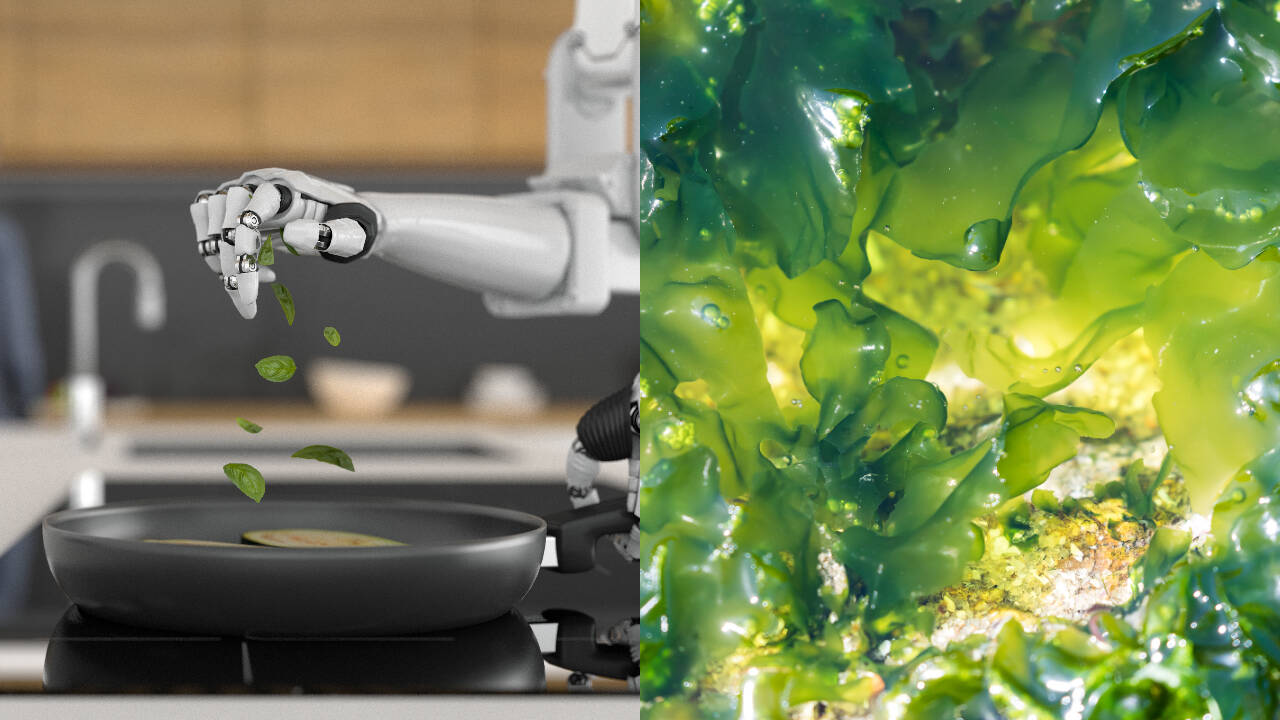
For decades, engineers assumed that building a robot required copper wires, lithium-ion batteries, and rigid electric motors. Delft University of Technology researchers just shattered that assumption with a two-centimetre strip of gel and living algae.
Forget complex mechanical joints. This miniature actuator bends, grasps, and lifts objects underwater entirely on its own, powered solely by light and biological metabolism. It's weird, it's fascinating, and it points toward an engineering philosophy that stops fighting biology and starts partnering with it.
How a Microscopic Strip Bends Without Electricity
When you look at traditional robotics, you see brute force. Servos whine, hydraulic fluid pumps, and circuits draw current. This living algae robotic arm operates on an entirely different plane.
Measuring just two centimetres long and one millimeter thick, the soft robotic strip looks unassuming. Yet, its movement is surprisingly sophisticated. The device consists of two distinct layers of hydrogel covered with living microalgae. When light hits the surface, the algae spring into action.
They don't just sit there. They photosynthesize.
Through photosynthesis, the microalgae consume carbon dioxide and light, while utilizing nitrogen to grow and divide. This biological activity fundamentally alters the chemical environment inside the surrounding hydrogel. Specifically, it triggers a shift in pH levels.
Here is where the brilliant material science comes into play. The two gel layers react differently to that pH shift. One layer swells more than the other. That uneven swelling creates a physical imbalance, forcing the entire strip to curve and bend.
When you turn off the light, the process reverses. The metabolism shifts in the opposite direction, and the actuator straightens back out. Response time clocks in at roughly ten seconds. You get a fully functional, light-controlled movement loop without a single spark of electricity or a single copper coil.
The Chemistry Behind the Movement
Most people misunderstand soft robotics. They think gels and polymers are just flimsy substitutes for steel and titanium. They aren't. They are active materials that respond dynamically to their surroundings.
In this setup, published in Nature Communications, the hydrogel acts as a mechanical translator. It translates microscopic biochemical changes into macroscopic physical motion. Think about how natural organisms move. Plants track the sun through differential cell growth and turgor pressure changes. Muscles contract via chemical ion exchanges.
The Delft team didn't invent a mechanical facsimile of a muscle. They built an actual biological-synthetic hybrid system.
The microalgae provide the metabolic engine. The hydrogel provides the structural skeleton and the responsive muscle tissue. When light illuminates the tank, the algae's internal chemistry shifts local acidity. The hydrogel absorbs or expels water in response.
You don't need a heavy battery pack. You don't need a microcontroller board. The light source itself serves as both the power supply and the control signal.
What Underwater Tests Actually Proved
Proof-of-concept experiments often stay trapped inside theoretical computer simulations. Not this one. The research team put their creation to work underwater to test its limits.
The miniature actuator successfully performed basic manipulation tasks. It hooked and lifted a rubber ring. It grasped a small metal ball.
Consider why underwater manipulation is notoriously difficult for traditional electronics. Waterproofing small motors, micro-servos, and wiring harnesses gets complicated fast. Corrosion, sealing failures, and electrical shorts plague deep-sea or aquatic robotics.
By removing conventional motors entirely, this design bypasses those electrical headaches. An aquatic environment is actually ideal for hydrogels, which naturally thrive and retain moisture underwater.
The implications for delicate object handling are massive. Rigid grippers often crush fragile marine samples, delicate tissues, or micro-components. Soft, light-powered actuators conform to shapes naturally. They apply gentle, distributed pressure that won't destroy what they touch.
Overcoming Engineering Misconceptions About Bio-Hybrid Robots
Skeptics love to dismiss bio-hybrid systems as lab novelties. They argue that living cells are too unpredictable, die too quickly, or react too slowly to be useful in real-world machinery.
That criticism misses the point of early-stage materials science.
No one is installing algal robotic arms into factory assembly lines tomorrow. That isn't the goal. The goal is expanding the material palette of engineering. For centuries, we built machines out of dead matter—metals, plastics, ceramics. We treated biology as something separate, something to be studied in biology labs while mechanical engineering stayed in the machine shop.
That wall is crumbling.
When you integrate living cells directly into functional materials, you unlock self-healing properties, adaptive responses, and energy efficiencies that synthetic materials cannot match on their own. Microalgae use light as an energy source for free. They repair themselves, grow, and respond to environmental stimuli autonomously.
Of course, challenges remain. Controlling algal growth rates over long lifespans, scaling up the output force, and stabilizing hydrogel structures in harsh environments require years of additional research. But dismissing the approach because it's currently at the proof-of-concept stage ignores how every major engineering breakthrough begins.
Where Soft Robotics and Biology Collide Next
The transition from rigid automatons to bio-integrated systems opens up entirely new categories of technology.
Look at architecture and climate control. Imagine smart shade blinds coated with light-responsive biological layers. As the sun beats down intensely, the material automatically curls and blocks the light, adjusting its orientation throughout the day without consuming grid electricity or requiring motorized actuators.
Look at agriculture. Automated systems could deploy biodegradable, light-responsive regulators in soil or water channels that react to changing environmental conditions without batteries or complex sensor arrays.
In marine exploration, bio-hybrid devices could drift through sensitive coral reefs or deep-sea ecosystems without disturbing local wildlife with electromagnetic fields or mechanical noise. They blend into the background because they are made of similar organic components.
The Delft study proves that movement doesn't require brute-force electromechanics. Sometimes, it just requires a little light, some clever chemistry, and an algae-infused gel. Stop thinking of robots as mere collections of chips and motors. The future of engineering is alive, adaptable, and surprisingly soft.