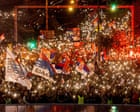
Thousands of mobile phone lights cut through the dark in central Belgrade, casting an amber glow over a crowd that refused to look away. Serbia is staring down a rare political reckoning. When 150,000 people flood Slavija Square just days before a national ballot, you stop ignoring the signs. This isn't just another routine election in the Balkans. It's a direct showdown between a stubborn political establishment and a youth-driven movement that refuses to stay quiet.
For over fourteen years, Aleksandar Vučić and his Serbian Progressive Party have gripped the nation's political machinery tightly. They built an entrenched system of patronage, controlled media channels, and sidelined genuine opposition. But monopolies on power eventually rot from the inside. The catalyst didn't arrive via a traditional political party or a charismatic veteran politician. It came from university lecture halls, triggered by concrete slabs crashing down at a railway station in Novi Sad.
The Tragedy That Woke Up a Generation
Back in late 2024, sixteen people died when a newly renovated station canopy collapsed. That disaster wasn't just an infrastructure failure. It exposed the rot of unchecked corruption, shady public tenders, and institutional negligence. Citizens had tolerated years of political friction, but dead teenagers beneath concrete were different.
The public anger didn't dissipate. Instead, university students took charge, transforming grief into an organized, persistent wave of civil disobedience. They didn't form a conventional political party right away. They organized as the Student List, placing academics, civic outsiders, and young reformers on a 250-seat parliamentary ticket.
When you look at how authoritarian regimes operate, they fear youth resistance because it lacks traditional vulnerabilities. You can't easily bribe or co-opt a leaderless movement that spreads organically across social networks and university campuses. Vučić tried his usual playbook. State media branded the protesters as foreign-funded agents trying to orchestrate a coup. Prosecutors questioned activists on dubious charges of plotting election day violence.
It didn't work. The fear is shifting sides.
Why This Election Feels Different
Serbia lacks reliable, independent polling infrastructure, making exact seat predictions a guessing game. Yet, the energy on the streets tells a story raw numbers cannot capture. People like 47-year-old Marija Nedeljkovic Radic, stepping out to support youth candidates for the first time in her life, represent a growing psychological shift. Regular folks are tired of living in a state where loyalty to a party card matters more than competence.
Vučić responded by rallying his loyalists inside a capital sports hall, warning of dark forces trying to dismantle the state. He resigned from his previous post specifically to run for prime minister, signaling how seriously his camp views this electoral threat. The rhetoric is sharp, defensive, and desperate.
If the Student List pulls off an upset on Sunday, the shockwaves will travel far beyond Belgrade. The European Union has long walked a careful tightrope with Vučić, balancing stability concerns against backsliding democratic norms. A democratic, youth-led government in Serbia would instantly reshape the geopolitical dynamics of the Western Balkans. It would prove that long-standing populist strongmen aren't invincible once citizens decide the cost of compliance is too high.
The whistles are blowing across Belgrade streets tonight. The ballots open in less than forty-eight hours. Watch what happens when a generation decides it has nothing left to lose.



