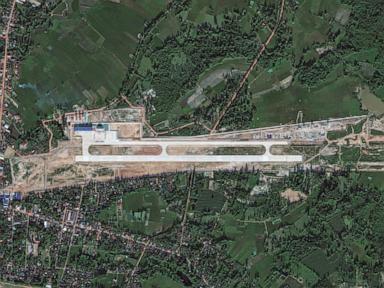
Look at a map of Southeast Asia and you'll see why Beijing's latest infrastructure project has defense analysts scrambling. China and Laos just officially opened the China-Laos Joint Support and Training Center and aviation academy at Ban Keun airfield, situated about 50 kilometers north of the Laotian capital Vientiane. Officially billed as a routine training facility to help the Laotian air force, satellite imagery tells a much louder story.
Construction kicked off in late 2025 on what used to be an old runway dating back to the Vietnam War era. Today, the site features a brand-new runway stretching roughly 2,000 meters, a parallel taxiway, and an apron with parking space for two dozen aircraft. That runway length is already long enough to handle fighter jets. Worse yet for regional rivals, open space around the facility leaves plenty of room to extend the strip by another 1,000 meters, which could easily accommodate heavy bombers and larger transport planes.
The Quiet Expansion Playbook
If this playbook feels familiar, you've been watching Beijing's overseas strategy over the last decade. Back in 2017, China established its very first overseas military base in Djibouti on the Horn of Africa. Then came the heavy funding and renovation work at Cambodia's Ream Naval Base in the Gulf of Thailand. Now, Laos becomes the third overseas military footprint and the second in Southeast Asia.
Experts point out that this isn't about building a massive, heavily fortified combat fortress overnight. Instead, it's about making small bets across the board that pay off strategically over time. Think of it less like playing poker with massive stakes and more like throwing darts at a roulette wheel until something hits.
Laos remains one of the poorest nations in the region and carries a heavy debt burden to China due to massive infrastructure projects like the high-speed rail line connecting Kunming to Vientiane. Analysts note that the airfield project serves as a target of opportunity. It gives Beijing valuable institutional experience in operating an air base on foreign soil while tightening its grip on continental Southeast Asia.
Regional Anxiety and the Vietnam Factor
While Beijing and Vientiane insist the facility is entirely peaceful and targets no third party, neighboring countries aren't buying the PR spin. Vietnam is watching the situation with intense anxiety.
Hanoi shares competing territorial claims with China in the South China Sea. Having a Chinese military-capable airfield positioned just across its western border places a fresh layer of strategic pressure on Vietnam. Think about flight paths and alternate routes. The Ban Keun facility gives the Chinese People's Liberation Army Air Force alternative paths to access disputed zones and monitor regional airspace without relying solely on domestic coastal bases.
For now, regional governments are taking official statements at face value publicly, but behind closed doors, military planners are recalculating their defense posture. Even though the Laotian air force currently operates only a tiny handful of combat-capable aircraft, a modernized joint facility opens the door for future acquisitions of Chinese fighter jets and deeper security integration.
Stop expecting grand announcements or dramatic base takeovers. Beijing prefers the slow drip of dual-use infrastructure projects that quietly tilt the geopolitical balance while everyone else is looking the other way.
Take a hard look at how infrastructure lending transforms into strategic positioning. The next time you hear about a friendly training academy opening up in a developing nation, check the runway length.