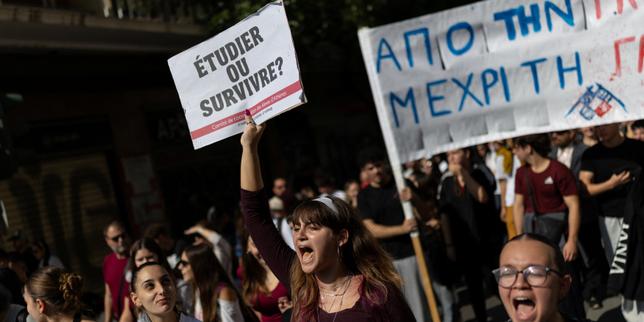
When thousands of students and teachers flood public squares, it is rarely out of sheer enthusiasm for political activism. More often, it stems from a breaking point. In Greece, anger has boiled over into the streets, with over 10,000 students and educators marching through Athens and Thessalonique. They aren't acting in a vacuum. Explicitly drawing inspiration from recent waves of youth mobilization in France, young Greeks are crying foul over soaring living costs, crumbling school infrastructure, and the continuous erosion of public education.
If you look past the standard political rhetoric, you will find a generation pushed to the edge by economic realities that make standard independence nearly impossible. Let's break down why this mobilization matters, what triggered it, and why European governments are struggling to contain youth discontent.
The Breaking Point of Greek Public Education
You cannot understand current protests without looking at the physical reality of Greek classrooms. Decades of underfunding have left visible scars on the country's education system. During recent protests in central Athens, teenage students pointed out basic hazards that illustrate the systemic decay—such as chunks of plaster falling off the walls inside school restrooms.
It is not just about peeling paint. Schools and universities face severe shortages of permanent staff, outdated equipment, and overcrowded lecture halls. When students look at the state of public services, they see a system designed to fail them.
Public education was once viewed as the primary engine for social mobility in Greece. Today, students feel it is being degraded to force families into expensive private alternatives. This exact dynamic mirrors the grievances voiced by French lycéens and university students who have regularly blocked campuses to protest similar austerity-driven reforms and declining resources.
The Housing Crisis and Economic Precarity
Education is only half the battle. The financial burden facing young Greeks has reached absurd levels. Rent prices in Athens and Thessalonique have skyrocketed, driven by inflation and short-term rentals.
According to economic indicators, inflation in Greece has consistently outpaced the eurozone average, creating an unsustainable squeeze on working-class families. For university students, finding an affordable apartment near campus is basically impossible without sinking deep into debt.
Because of these structural costs, a massive share of young adults in Greece are forced to live with their parents well into their late twenties. When you combine high youth unemployment rates with precarious job prospects upon graduation, the social contract breaks down completely. Young people look at their future and see a permanent loop of financial insecurity.
Why the French Example Resonates
Solidarity between European protest movements is nothing new, but the reference to France carries specific weight. When French students organize mass walkouts, block high schools, and clash with authorities over pension reforms, education budgets, or living standards, the images travel fast across social media platforms.
Greek protesters explicitly chanted slogans echoing their French counterparts, adopting the mindset of "same problems, same enemy." To these students, the struggles of the French working class and youth validate their own anger. It proves that dissatisfaction with neoliberal economic policies is a pan-European issue, not an isolated Greek phenomenon.
Labor unions like Adedy, representing Greek civil servants, joined forces with student organizations during these demonstrations. By linking student demands with broader calls for wage increases and public sector investments, the movement gained immediate political leverage.
What Happens Next
Governments in Athens face a delicate balancing act. Dismissing these protests as typical student unrest ignores the underlying economic data. When inflation hits hard and basic survival becomes a daily stress test for households, young people have little left to lose by protesting.
If state officials fail to address structural issues like affordable student housing, deteriorating school buildings, and decaying public services, these demonstrations will only grow. The youth are no longer willing to quietly accept a future defined by precarity.
Stop pretending these protests are brief disruptions. They are symptoms of a wider systemic failure that requires immediate policy intervention, not temporary Band-Aids.
Check out this Greek youth protest report to see how international media covers these student movements. This video provides additional context on how youth activism is spreading across Europe to challenge economic inequality.



