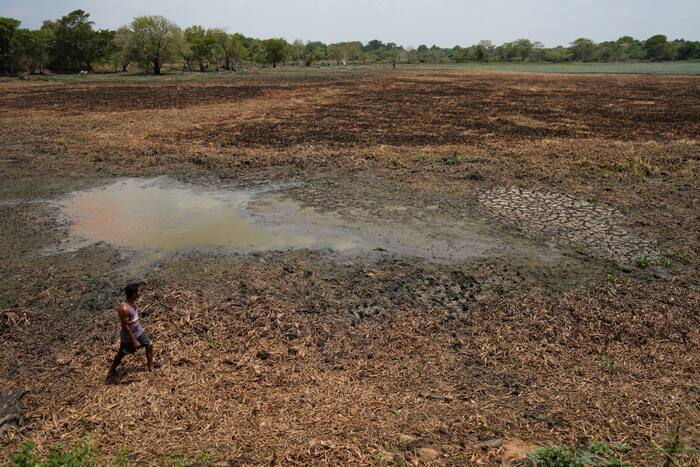
When the monsoons fail in Sri Lanka, the crisis doesn't arrive quietly. It starts at the bottom of a dry well, where families drop buckets into empty red clay and pull them up completely bone-dry.
Right now, rural farming communities across the island are living through a punishing drought that has left national reservoirs hovering near one-third capacity. Rice paddies that should be vibrant sheets of green have baked into cracked, dusty crusts. In regions like Medirigiriya, smallholders who survived decades of civil conflict are staring down a new kind of threat, drowning in agricultural debts after four months of zero rainfall while facing daily temperatures soaring past 35 degrees Celsius.
This isn't just an agricultural emergency. It’s a full-scale ecosystem squeeze. Inside iconic wildlife habitats like Yala National Park, elephants, spotted deer, and wild buffaloes are abandoning parched interior zones, converging tightly around whatever mud-crusted water holes remain. When nature's plumbing breaks down entirely, humans and wildlife find themselves fighting for the exact same drops.
The Perfect Storm of El Niño and Changing Weather Patterns
Why is Sri Lanka's water crisis hitting so hard right now? The island depends heavily on two seasonal monsoon cycles to fill its seventy-four major reservoirs. Normally, the southwest monsoon brings up to thirty percent of the annual rainfall between May and September. This year, that vital window largely missed its mark.
Climate scientists point to a strong El Niño phase—a natural warming of ocean surface waters that alters global atmospheric pressure and rainfall distribution—colliding with long-term atmospheric warming trends. Local meteorologists note that while pinning every single dry spell squarely on human-driven climate change requires continuous tracking, the frequency and intensity of these extreme swings have accelerated.
Farmers like Vidanaarachchige Wimalasuriya know this whiplash firsthand. Only a year prior, heavy floods swamped his homestead and washed over his fields. Now, he’s harvesting a meager six sacks of rice out of an expected fifty, unable to access moisture when his crops needed it most. That erratic pendulum swing from excess water to absolute arid dust is the new normal for South Asian agrarian economies.
When Wells Run Dry and Debt Piles Up
For small-scale farmers, a failed season triggers an immediate financial catastrophe. Many operate on micro-loans secured for seeds, fertilizer, and tractor rentals.
Take Indika Nuwankumara, a father of three managing an eight-acre plot. Without rain, his investments in rice, okra, and eggplant vanished. He’s now on the hook for a fifteen-hundred-dollar debt with zero harvest income to offset it. Day-to-day survival takes priority over crop planning. Government trucks and local charities now roll down dirt roads supplying emergency drinking water in plastic barrels and jerrycans, turning basic hydration into a scheduled relief event.
The heat itself complicates physical labor. Daytime temperatures are so oppressive that running fans indoors merely circulates stifling, heated air. Working under an unrelenting sun leaves farmers vulnerable to severe heat stress long before they reach their withered fields.
The Wildlife Squeeze at Yala National Park
The crisis extends far beyond human settlements. In Yala National Park, spanning a thousand square kilometers in the country's southeast, the landscape is gasping for moisture.
Normally, creatures like water buffaloes, crocodiles, elephants, and leopards disperse across a network of natural ponds and streams fed by the Menik River. Today, many of those natural ponds have evaporated into cracked mud flats. Animals are crowding tightly around shrinking water pools, depleting local food sources and raising the risk of human-wildlife conflict as thirsty elephants wander closer to farming villages looking for moisture and vegetation.
Park rangers and wildlife authorities are fighting a losing battle against evaporation, dragging long hoses across dry earth and deploying water tankers to artificially fill small artificial ponds. These stopgap measures keep iconic species alive, but they are heavy, resource-intensive Band-Aids on a vast environmental wound.
What Needs to Happen Next
Scattered rain showers bring temporary psychological relief, but climate experts emphasize that brief downpours do nothing to restore deep groundwater tables or refill massive irrigation tanks that power the nation's food security.
To break this cycle, rural infrastructure needs a complete overhaul. Relying on age-old monsoon predictability is no longer a viable strategy for South Asia. Agricultural authorities must pivot toward drought-resistant crop varieties, expand localized rainwater harvesting systems, and upgrade outdated canal networks to minimize evaporation losses.
Without aggressive adaptation strategies, generations of generational farming knowledge will vanish into the dry dust of a changing climate.



