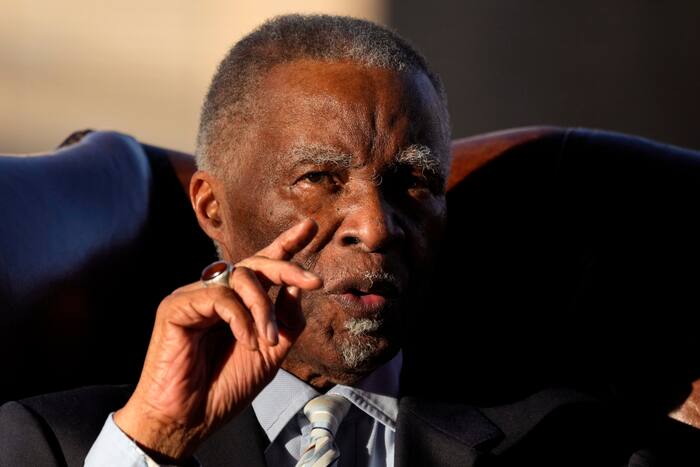
Decades have passed since the fall of white minority rule, yet South Africa is still wrestling with the ghosts of its violent past. Former South African President Thabo Mbeki stepped up to a judicial inquiry in Johannesburg to answer heavy accusations. He flatly denied ordering prosecutors to drop apartheid era criminal cases or cutting secret deals to protect former security officers from accountability.
If you've followed South African politics, you know the shadow of the Truth and Reconciliation Commission looms large. Mbeki's testimony brings the country's ongoing struggle for historical justice back into sharp focus. Let's look at why these old wounds refuse to heal and what this recent inquiry actually means.
The Weight of Unresolved Apartheid Crimes
When apartheid ended in 1994, the African National Congress took power with a monumental mandate. They had to transition a deeply fractured nation into a constitutional democracy. Archbishop Desmond Tutu led the Truth and Reconciliation Commission starting in 1996, offering amnesty to perpetrators who made full disclosures about politically motivated crimes.
It sounded like a clean slate. It wasn't.
About 7,000 amnesty applications poured in. The commission granted roughly 850, refused about 5,400, and referred around 300 cases to the National Prosecuting Authority for further investigation.
Decades later, only a tiny fraction of those referred cases resulted in trials. Victims' families are tired of waiting. They filed lawsuits against successive governments, accusing leaders of trading justice for political stability and national reconciliation. That legal pressure forced President Cyril Ramaphosa to establish the current judicial inquiry.
What Thabo Mbeki Said Under Oath
Mbeki served as president from 1999 to 2008, succeeding Nelson Mandela. Critics have long accused his administration of blocking investigations to appease former military figures and maintain peace during a fragile democratic infancy.
In his written and spoken statements before the inquiry, Mbeki pushed back hard. He stated he never directed, authorized, or approved the suppression of investigations or prosecutions. Instead, he argued that the National Prosecuting Authority must answer for its own failures to pursue the truth commission's referrals.
Mbeki acknowledged meeting with former military and police officers. However, he insisted those discussions were meant to encourage their participation in the truth commission, not to hand them immunity. He also defended a controversial 2003 parliamentary address where he mentioned lawful arrangements with people willing to disclose past crimes, maintaining that his words applied to individuals outside the formal amnesty process and did not override the prosecution authority's independence.
The Battle Lines Are Drawn
The inquiry itself has faced fierce resistance. Mbeki and his successor, Jacob Zuma, tried to force retired Constitutional Court Justice Sisi Khampepe to recuse herself, claiming her past work with the truth commission and prosecution authority compromised her impartiality. The Constitutional Court dismissed the challenge outright.
Victims' groups aren't holding back either. Zaid Kimmie, executive director of the Foundation for Human Rights, voiced the frustration shared by dozens of families who feel betrayed by institutional delays. Witnesses are dying. Evidence is vanishing. Every year that passes makes a real courtroom victory less likely.
At the same time, authorities have reopened inquests into iconic historical figures, including the 1977 death of Steve Biko in police custody, the 1967 death of Nobel Peace Prize winner Albert Luthuli, and the 1981 killing of lawyer Griffiths Mxenge. These reopenings offer a glimmer of hope, but they also highlight how long overdue accountability really is.
Where South Africa Goes From Here
The inquiry is rolling forward with testimony from former cabinet ministers and other key political figures. The core tension won't disappear when the hearings conclude. South Africa chose reconciliation over Nuremberg-style trials in the 1990s to avert a full-scale race war. That choice saved the country from immediate catastrophe, but it left a bitter legacy for the families of those who died fighting the regime.
You cannot fast-forward through historical trauma. As long as files sit gathering dust and suspects pass away of old age, the demand for clear answers will persist. South Africa's leaders must face these hearings not as a political trial, but as a final reckoning with the true price of their democratic transition.



