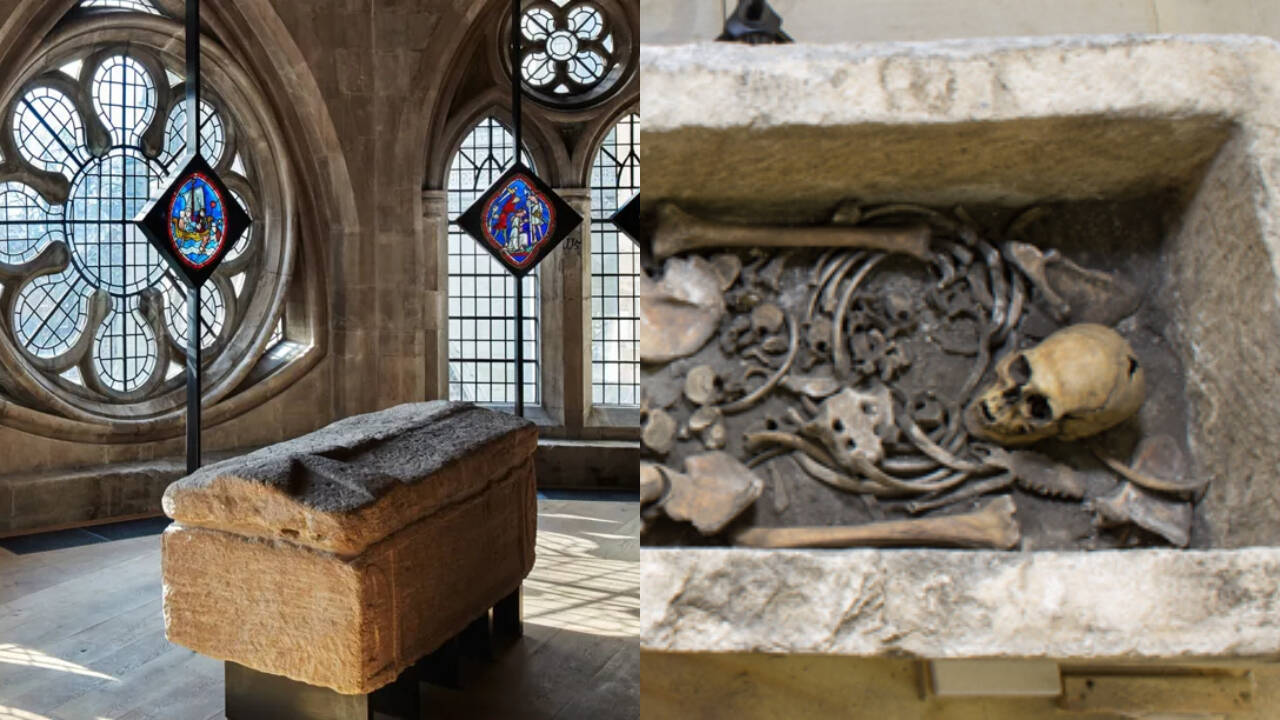
For more than a hundred years, tourists and historians looked at a weathered stone sarcophagus tucked away at Westminster Abbey and trusted a name carved into it. The inscription pointed straight to Valerius Amandinus, a wealthy Roman-era resident who supposedly lived sometime between AD 300 and 400. It was a neat, tidy piece of history carved in stone.
Except it was completely wrong.
Recent radiocarbon testing carried out by the Scottish Universities Environmental Research Centre turned that entire narrative upside down. The skeleton resting inside the limestone container didn't belong to a fourth-century Roman at all. Bone samples place the individual squarely between AD 987 and 1052, landing right in the late Saxon period.
If you've ever wondered how medieval institutions recycled ancient artifacts, this discovery gives us a front-row seat. People back then didn't look at Roman ruins as sacred museums to be left untouched. They saw a high-end, pre-made stone box and thought it was too good to waste.
The Long Road From Discovery to Modern Science
The artifact's journey into modern awareness started long before carbon dating was even a blip in anyone's imagination. Workers first stumbled upon the limestone sarcophagus back in 1820 while laboring on the north side of Westminster Abbey, accidentally cracking its heavy lid into six separate pieces. They patched it up, but it wasn't formally excavated on the North Green until 1869.
At the time, nineteenth-century archaeologists relied heavily on what was visible on the surface. The inscription bearing the name Valerius Amandinus dominated the narrative. It made sense to assume the man buried inside was the person named on the outside.
Yet, anomalies stared researchers in the face for decades. Etched into the lid was a prominent Latin cross styled directly after tenth or eleventh-century designs. Roman Britain didn't feature that specific Christian iconography centuries before Christianity became the dominant imperial framework under Constantine in the way it manifested here. The style mismatch screamed reuse, but nobody had the scientific tools to prove it until now.
Who Was Actually Inside the Coffin?
Clearing away the Roman identity leaves a massive historical vacancy. If the remains belong to someone from the late Saxon era, who actually earned the right to be tucked inside an elite stone container right at Westminster Abbey?
Consultant archaeologist Warwick Rodwell zeroed in on two primary candidates who match the radiocarbon window: Aelfwig and Wulnoth. Both men served as medieval abbots when the abbey operated as a Benedictine monastery. Aelfwig died around 1020, while his successor Wulnoth passed away in 1049. Both timelines align neatly with the newly established dates for the skeletal remains.
Human bone specialist James Young Langthorne of Pre-Construct Archaeology analyzed the bones and painted a vivid physical portrait of the occupant. The man stood roughly five feet nine inches tall and died when he was between 35 and 49 years old. That contrasts sharply with initial nineteenth-century guesses that claimed the bones belonged to a robust young man under thirty.
Clues Left Behind in the Dirt
Archaeology isn't just about what survives intact; it's about reading the ghostly traces of what vanished. When researchers examined the soil around the sarcophagus, they found a distinct white lime residue outlining a rectangular shape.
That wasn't random mineral deposits. It was the negative space left behind by a rectangular wooden coffin that once housed the body before it was lowered into the heavy stone container. Over a thousand years underground, the timber completely rotted away, leaving only chemical whispers in the dirt.
Putting it all together paints a picture of a high-status burial. You didn't get a repurposed Roman sarcophagus and a secondary wooden casing unless you held massive power within the church. It was an expensive, deliberate statement of legacy, even if the person who planned it accidentally hijacked an ancient Roman's nameplate in the process.
History rarely hands us clean, unbroken lines from the past. Sometimes it takes modern science to expose the clever recycling projects of medieval monks who cared more about securing a prestigious resting place than respecting Roman property lines.



