For decades, if you wanted to transmit a radio signal, you needed a hunk of heavy metal. Copper wires, aluminum rods, and rigid dipole elements have anchored our communication infrastructure since Marconi's early experiments. But what if you could swap out solid hardware for pure light?
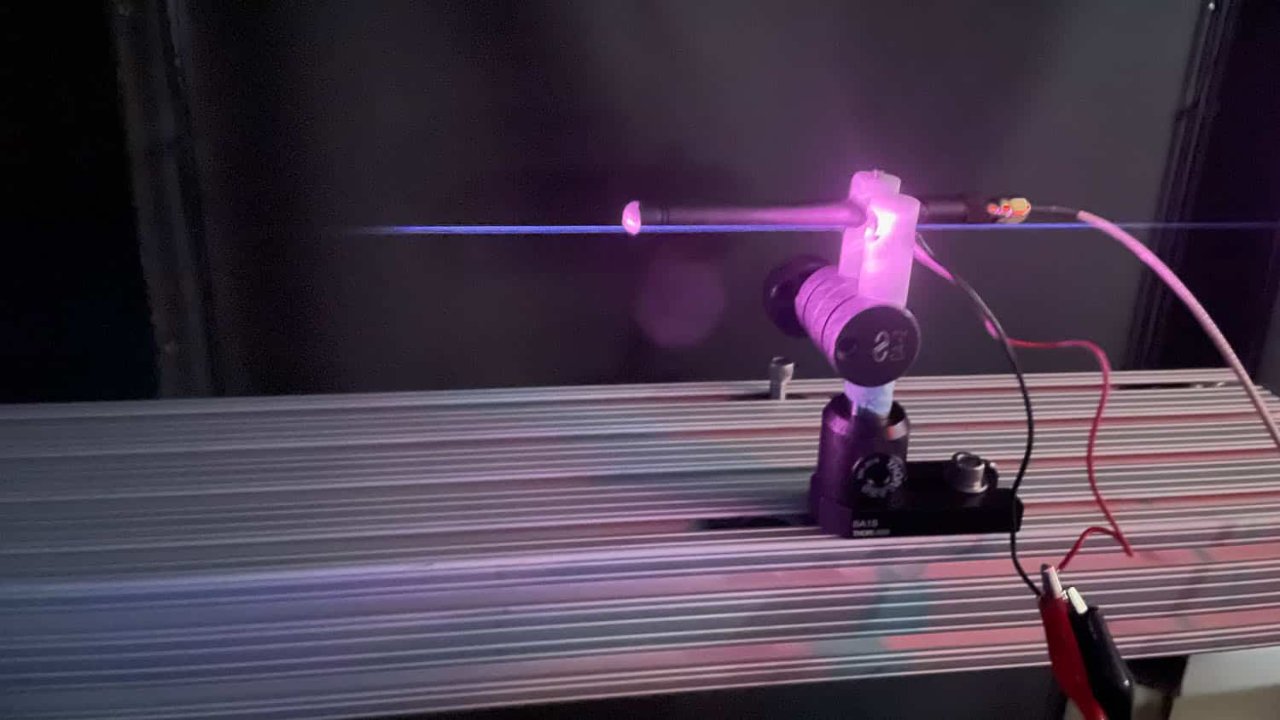
Researchers at North Carolina State University just demonstrated a plasma antenna powered entirely by laser beams. It looks like a sci-fi prop, acting much like a glowing lightsaber, but the implications for aerospace and defense engineering are entirely grounded in hard physics.
How a Beam of Light Transmits Radio Waves
Traditional antennas rely on physical conductors to guide oscillating electrical currents and radiate electromagnetic waves into space. The NC State team bypassed physical metal entirely by utilizing a laser-induced plasma filament.
When you fire an ultra-short laser pulse—in this case, running at 100 femtoseconds with a 1 kilohertz repetition rate—into the air, it ionizes atmospheric gases. This intense energy creates a microscopic plasma channel roughly 20 centimeters long and a tiny fraction of a millimeter wide.
Electrons naturally crowd around the outer edges of this glowing conduit. That electron concentration gives the ephemeral filament the exact electrical properties needed to support the propagation and radiation of radio frequencies.
Solving the Contact Problem
The main roadblock wasn't just creating plasma; it was figuring out how to feed a radio signal into a beam of air without destroying it. If you touch a physical wire to a plasma channel, you disrupt the ionization and ruin the structure.
To solve this, the researchers built a capacitively coupled antenna feed. Instead of making direct physical contact, this metal structure generates a localized electromagnetic field around the filament. A generator pumps a 30 megahertz signal into the feed, which transfers the energy straight into the plasma via non-contact coupling.
When the team tested the setup, the numbers caught everyone's attention. With the laser active and the plasma filament guiding the wave, the received signal strength shot up by 2.5 times compared to running the feed alone. That is a massive 150 percent boost in performance from a temporary channel made out of ionized gas.
Why This Matters for Satellites and Aircraft
Metal antennas are heavy, fixed in shape, and mechanically limited. If you want to change an antenna's operating frequency or beam direction on a satellite or fighter jet, you usually need motors, gimbals, or complex switching arrays that add dead weight and potential points of failure.
A laser-driven plasma antenna changes the calculus completely. Because you create the antenna using a laser, you can control its length simply by tweaking your optical parameters. Want a different frequency response? Adjust the laser. Need to steer the beam instantly? Just redirect the laser beam itself.
Admittedly, this work is still in the proof-of-concept stage. The current laboratory prototype has relatively low gain and cannot yet match the intense beamforming precision required for operational synthetic-aperture radar or long-range deep-space communication.
What Comes Next for Plasma Antennas
Moving from a 20-centimeter lab demonstration to a deployable commercial system requires solving significant engineering bottlenecks. The team needs to scale up filament lengths to several meters for high-frequency and very-high-frequency applications. They also need to optimize the contactless feed efficiency and validate electromagnetic reciprocity so the same plasma structure can receive signals just as effectively as it transmits them.
We aren't throwing away copper dipole antennas tomorrow. But this breakthrough proves that the physical constraints holding back modern wireless design are starting to melt away under the heat of high-powered lasers.