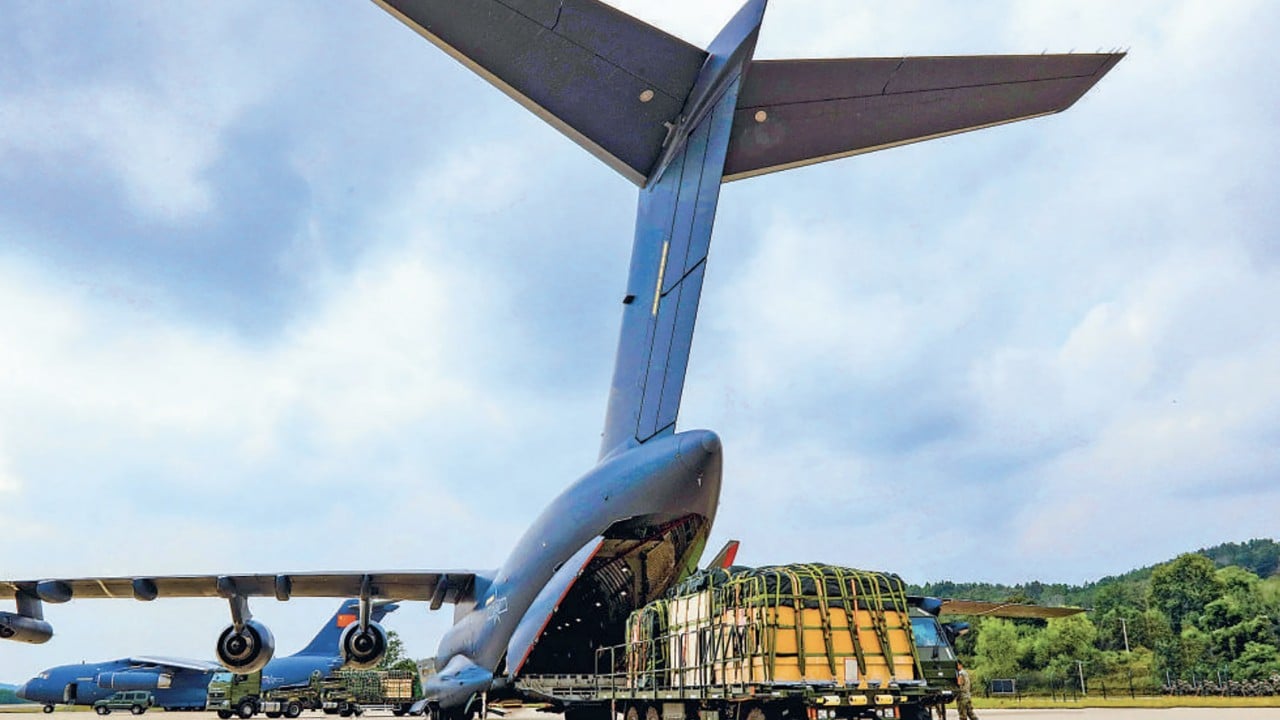
Military logistics aren't glamorous. But they win wars. When the Chinese air force recently published training footage featuring a Y-20B heavy transport equipped with underwing refueling pods, defense analysts took notice. This isn't just another cargo plane with a fresh coat of paint. It signals a major shift in how Beijing plans to extend air combat reach across the western Pacific.
For years, critics dismissed Chinese aerial refueling capabilities as a bottleneck. The older YY-20A tankers filled a vital gap, but numbers remained limited, forcing planners to rely on smaller fleets of modified bombers or legacy aircraft. The Y-20B changes the math completely. By integrating four homegrown Shenyang WS-20 turbofan engines and engineering the platform for a multi-role tanker-transport configuration, the People's Liberation Army Air Force is solving its range problem in plain sight.
Let's look at why this specific aircraft matters so much right now.
The Power Behind the Upgrade
Old variants of the transport relied on imported or legacy engines that limited efficiency and heavy-load performance. The transition to the high-bypass WS-20 engine has completely transformed the platform. You get better fuel efficiency, higher thrust, and shorter takeoff distances from rough strips.
When you strap refueling pods onto a heavy airlifter powered by four WS-20 engines, you unlock a dual-threat capability. The aircraft carries enough internal fuel to service medium and heavy fighters without needing auxiliary tanks crammed into the cargo bay. That leaves the main deck wide open for troops, palletized equipment, or humanitarian gear.
Military commentator Fu Qianshao recently highlighted this exact flexibility during state media broadcasts. Instead of choosing between moving cargo and supporting fighters midair, commanders can accomplish both missions with a single airframe. That kind of operational efficiency multiplies force projection overnight.
Extending Reach Into the Western Pacific
Distance is the ultimate adversary in modern air warfare. Combat aircraft like the J-20 stealth fighter have incredible onboard sensors and weapons, but physics still dictates that fuel burns fast during high-speed intercept or strike missions. Without reliable midair refueling tankers stationed close to operational zones, fighter jets quickly hit a hard operational ceiling.
By turning the Y-20B into an aerial tanker, the air force isn't just adding planes to a roster. They're stretching combat radiuses far beyond mainland bases. During potential contingencies near Taiwan or the broader South China Sea, having a flexible fleet of heavy multi-role tankers keeps fighters airborne longer, deep into contested airspace.
Think of it as building gas stations in the sky exactly where you need them. While dedicated tankers like the YY-20A carry massive fuel loads akin to Soviet-era Ilyushin designs, mixing in convertible transport variants provides commanders with scalable logistics. If a base needs cargo one day and fuel pipelines the next, the same basic airframe handles both jobs.
The Expanding Y-20 Family
The Kunpeng family has grown up fast since its initial flight tests over a decade ago. Affectionately nicknamed the "Chubby Girl" by aviation spotters for its wide fuselage, the baseline transport has evolved into a diverse fleet.
You now have the original Y-20A, the upgraded Y-20B with domestic powerplants, dedicated YY-20 tankers, and specialized airborne early warning variants like the reported KJ-3000 platform. Each new iteration reduces reliance on foreign components and refines the domestic aerospace manufacturing base.
Official training images don't get released by accident. Publishing photos of the Y-20B in an active refueling configuration serves as an intentional signal to regional competitors. Beijing wants observers to know that logistics bottlenecks are closing and strategic airlift capacity is scaling up year over year.
Look past the parade displays and standard training drills. The real story here is industrial maturity and sustained operational reach. As more units adopt these multi-role platforms, the tactical landscape across the region shifts. Air power isn't just about how fast your fighters fly anymore. It's about how long you can keep them up there.