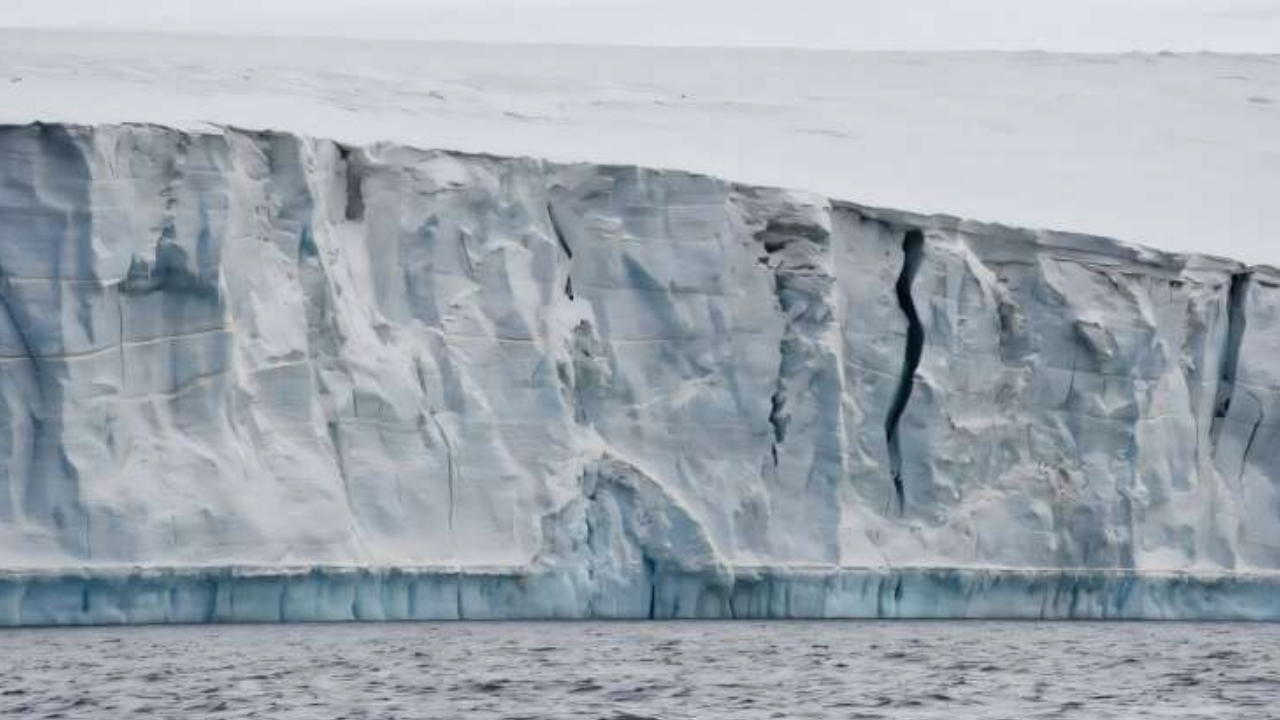
For years, climate models warned us about a terrifying scenario. When towering ice shelves shatter, they expose massive vertical cliffs at the edge of glaciers. According to the theory of marine ice-cliff instability, any sheer ice face towering more than 100 meters above sea level should trigger a catastrophic chain reaction. The immense weight of the ice makes it structurally unstable, causing it to fracture, crumble, and expose an even taller cliff further inland in a relentless, unstoppable march toward total collapse.
It sounds like a sci-fi disaster movie plot. But real-world physics rarely obeys our most panicked predictions.
A recent study published in the journal Science by researchers from MIT and the Woods Hole Oceanographic Institution looked at 15,330 satellite observations collected by NASA's ICESat-2 between 2019 and 2023. What they found upended standard assumptions about glacier cliffs retreat and stabilise dynamics. Ice sheets do move fast under pressure, but they don't necessarily keep collapsing forever.
What the Satellite Data Actually Revealed
Scientists analyzed thousands of laser altimetry measurements to track how tall ice cliffs evolve over time. They wanted to test whether the theoretical 100-meter threshold really acts as a point of no return for retreating glaciers.
The data delivered a major surprise. While the average ice cliff hovers around a modest 30 meters high—well below the danger zone—the researchers did locate regions with exceptionally tall formations. In fact, they tracked specific Antarctic cliffs reaching up to approximately 127 meters in height.
When those colossal walls of ice began to fail, they collapsed much faster than existing computer simulations anticipated. That part of the worst-case models was right. Glaciers can experience intense, rapid initial retreats when exposed to warm ocean water and structural stress.
The Surprising Braking Mechanism
Here is where the computer models got it wrong. Instead of marching steadily inland and destroying entire ice sheets in an endless domino effect, those rapidly retreating glaciers hit a natural brake and stabilized.
Why did the collapse stop? The answer lies in messy, complex real-world variables that simple theoretical models used to overlook.
First, look at what happens right at the front of the glacier. As ice breaks off, it creates a thick slush of icebergs, broken chunks, and sea ice known as mélange. Researchers found a clear link between thicker mélange packs and stable cliffs. This floating rubble acts like a stubborn buffer zone, pushing back against the glacier front and holding the line against further rapid calving.
Second, water depth plays a massive role. Deeper water beneath a floating or grounded ice margin provides greater buoyant support, changing the stress distribution across the face of the ice.
Third, and perhaps most importantly, the landscape beneath the ice dictates everything. Bedrock isn't flat. When a retreating glacier hits raised bumps or ridges in the underground topography, the ice above those elevated spots thins out dramatically. Once an ice cliff loses height through calving and thinning, it simply falls below the critical stress threshold required to maintain rapid collapse. Physics intervenes, and the runaway retreat fizzles out.
What This Means for Future Sea-Level Rise
Let's be clear. This research doesn't mean Antarctica is safe from climate change, nor does it give humanity a free pass to ignore rising global temperatures. Ice loss is real, and sea levels are still climbing.
What this study changes is our precision. If old models underestimated how fast tall cliffs can initially shatter, they were wrong about short-term dynamics. But by assuming every single collapse automatically triggers an unstoppable chain reaction, those same models likely exaggerated the long-term catastrophe.
Climate science is messy. Translating satellite observations into accurate future projections requires ditching rigid mathematical assumptions in favor of actual geological feedback loops.
How to Follow the Science Without the Panic
When you read headlines about collapsing ice sheets, remember that reality is usually more nuanced than a catastrophe broadcast.
- Look past averages: Glaciers respond to local conditions like water depth and bedrock topography, not just global temperature trends.
- Watch the topography: The shape of the land beneath the ice dictates where a glacier stops as much as how fast it melts.
- Distinguish short-term speed from long-term fate: Fast initial retreat doesn't automatically mean endless collapse.
Researchers are now working to feed these new variables—bedrock bumps, ice thinning rates, and mélange dynamics—into the next generation of ice-sheet models. We're getting better at separating true existential tipping points from temporary physical adjustments.