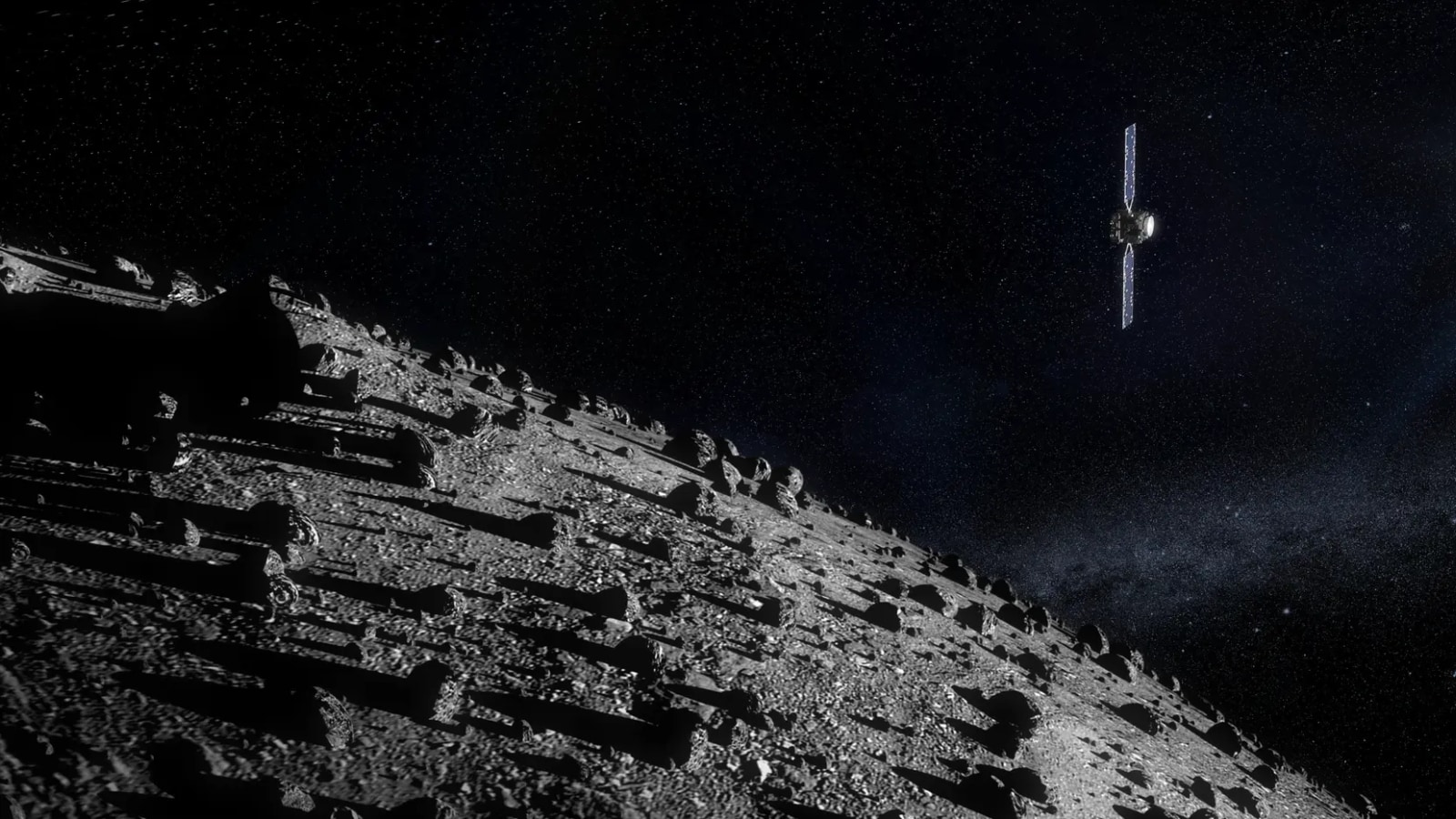
Punching a space rock at nearly 15,000 miles per hour sounded bold on paper in 2022. Now we get to see what actually broke.
Europe's Hera spacecraft just sent back close-up views of Dimorphos, the small moonlet around Didymos that NASA's DART slammed into back in September 2022. Instead of a neat little dent or a harmless bounce, the side hit by DART is flattened into a stadium-sized scar stretching across almost the entire width of the asteroid. And Dimorphos isn't tidily tidally locked anymore. It's tumbling chaotically in orbit.
Honestly, that combination surprises even planetary scientists who spent four years modeling what a rubble pile would do. Earth-based telescopes told us DART shaved about 33 minutes off Dimorphos's orbital period, blowing past NASA's modest 73-second benchmark for success. Yet telescopes can't show you the aftermath up close. Hera, launched in October 2024 and surveying the binary pair from roughly 25 to 30 kilometers out, finally gives us eyes on the crime scene.
What Hera Actually Saw on Dimorphos
Before Hera's arrival, researchers argued over three basic possibilities. Did DART carve a distinct crater? Did it reshape the whole moonlet? Or did a loosely bound rubble pile basically absorb the punch and stay mostly intact?
According to Hera principal investigator Patrick Michel of CNRS and the Observatoire de la Côte d'Azur, the answer turned out to be all three at once. The struck face of Dimorphos—a roughly 151-meter-wide body orbiting the 730-meter Didymos—looks flattened by a giant impact feature nearly spanning its width. Meanwhile, the far side and other regions still show boulder fields that look remarkably familiar compared with DART's final pre-impact snapshots.
That contrast matters. A rubble-pile asteroid isn't a single slab of solid granite. It's a loose collection of rocks, dust, and boulders held together by tiny amounts of gravity. When a roughly half-tonne spacecraft hits that kind of structure, momentum doesn't just come from the spacecraft itself. Blasted-out ejecta acts like a rocket exhaust pushing the target in the opposite direction.
"After four years of waiting and speculating we can finally see what Dimorphos looks like. Where there was once a rounded face is now a big crater almost as large as the body itself, which is really spectacular." — Sabina Raducan, planetary scientist at ISSI and Vrije Universiteit Brussels, speaking at an ESA mission briefing
Three details stand out right away from Hera's initial look:
- A stadium-sized flattened face: The impact zone didn't leave a tiny bowl. It reshaped the struck flank across a huge span of the moonlet.
- Chaotic tumbling: Instead of steadily keeping one face toward Didymos like our Moon keeps toward Earth, Dimorphos is rolling and tumbling wildly through its orbit.
- Hundreds of orbiting boulders: Hera spotted hundreds of meter-scale boulders circling the Didymos system, a fresh hazard the spacecraft team has to navigate carefully as it moves closer.
Didymos, the bigger parent body, shows no obvious signs of major change from the collision. Which makes sense given its size difference, though Hera is still studying the wider system.
Why Chaotic Tumbling and Flying Boulders Are a Big Deal
Here's the mistake people make when they hear "deflection worked." They picture planetary defense like a clean pool shot. Hit the cue ball, sink the eight ball, calculate the angle with a neat equation, done.
Real asteroids don't play pool. A rubble pile with irregular shape, weak internal strength, and loose surface boulders behaves unpredictably. As Dr. Ian Whittaker, a senior lecturer in physics at Nottingham Trent University, has pointed out in coverage reported by The Guardian, deflecting an asteroid isn't as simple as adding up two vectors on a whiteboard. How much material gets launched into space, how fast it leaves, and how the remaining body wobbles or tumbles all affect the final trajectory.
Chaotic rotation isn't just a quirky footnote, either. If a hazardous asteroid starts tumbling unpredictably after a kinetic impactor hits it, tracking its spin state, thermal emission, and future motion gets harder. And if a kinetic strike blasts hundreds of boulders into orbit around a binary system, a follow-up observation mission—or a second deflection attempt—has to dodge debris clouds that weren't there before.
On the flip side, that debris has huge scientific value. Astronomer Michaël Marsset at the European Southern Observatory noted that unlike natural space collisions, DART had a known mass, speed, and impact angle. Peering into the crater and debris lets scientists see fresh subsurface material that's been shielded from space weathering, giving a rare look at what's hiding beneath an asteroid's crust.
What Happens Next With Hera and Planetary Defense
Hera isn't finished, and honestly the best data is still ahead. Operating at very slow relative speeds—around 12 centimeters per second in carefully managed trajectories—the spacecraft plans to edge closer, down to roughly 13 kilometers in December, before deploying two shoebox-sized CubeSats in January 2027. One of those small spacecraft, Milani, is designed to study surface materials and dust, while Juventas will use radar to probe the interior structure of Dimorphos.
ESA Director-General Josef Aschbacher has framed the pairing of NASA's DART and ESA's Hera as international cooperation turning a one-time demonstration into real engineering knowledge. That matters because the goal isn't just knocking a harmless moonlet off course for science points. It's building a playbook we can trust if an actual threat ever turns up.
Europe is already looking beyond Didymos. ESA is developing the Ramses mission with JAXA to study asteroid Apophis during its famous, safe close flyby of Earth on April 13, 2029. Seeing how space rocks behave under real forces—both spacecraft impacts and close planetary gravity—is how humanity moves from luck and theory to genuine preparedness.
What You Should Do With This News
If you follow space policy, science communication, or planetary defense, don't stop at the headline "stadium-sized crater." Most quick summaries skip the operational trade-offs that engineers care about most.
- Read the primary mission updates: Check the European Space Agency Hera mission page for instrument notes from the Asteroid Framing Camera, thermal imager, and spectral instruments as Hera moves inside 13 kilometers.
- Watch the CubeSat deployment milestones: Track the January 2027 deployment of Milani and Juventas, since radar sounding of Dimorphos's interior will test how much empty space or loose rubble sits beneath that flattened face.
- Separate "orbit shifted" from "problem solved": When you see future stories on asteroid deflection, look for details on ejecta momentum, spin changes, and debris fields—those are the variables that turn a rough experiment into a reliable defense method.