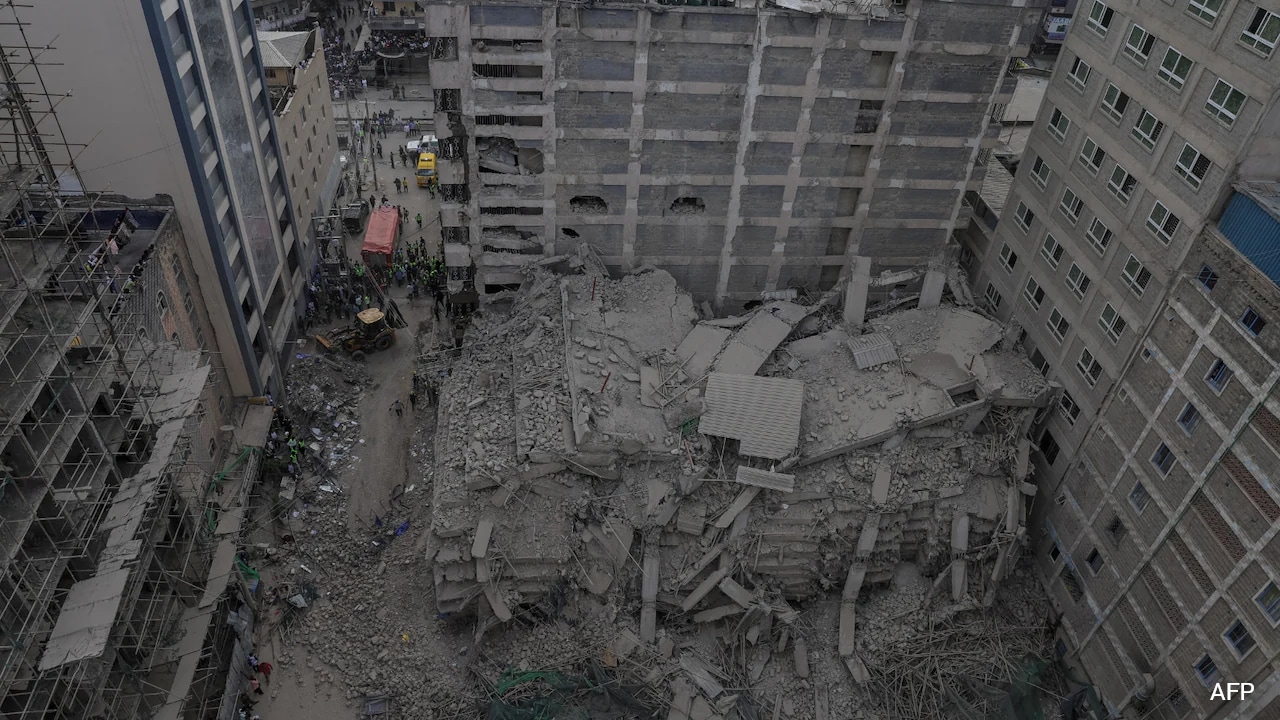
Pancaked floors. Crushed concrete. Desperate families waiting behind police lines while rescue workers pry through rubble with tree branches and basic tools.
When a multi-storey building collapses in Nairobi's busy Eastleigh district, it's never just an accident. It's the predictable outcome of regulatory failure, illegal early occupancy, and systemic negligence that treats human life as cheap overhead.
Let's look at what actually happens when rapid urbanization outpaces safety infrastructure, and why the cycle keeps repeating.
The Anatomy of a Nairobi Disaster
At roughly 1 p.m. on a busy Friday, a massive multi-storey structure caved in on itself along a crowded commercial street in Eastleigh. The building had more than ten upper floors under active construction, while the ground level and basement already housed active businesses like an electronics shop, a butchery, and a grocery store.
That setup alone tells you everything you need to know about the breakdown of safety controls. According to Nairobi Governor Johnson Sakaja, while the structure had initial construction permits, it never received a certificate of occupation. Opening ground-floor retail shops while heavy construction continues overhead is a blatant violation of basic engineering law. Yet, it happens every single day across the capital.
When the structure gave way, it stacked floors together with almost no space in between. Workers inside had seconds to react. Joseph Kaula, a plasterer working on the fifth floor, barely escaped. He reported hearing screams and watching coworkers bolt for the door just as dust choked the entire street. He suspects several colleagues were trapped in the basement.
The Chaos of Immediate Response
When disaster strikes a densely populated district, emergency response is rarely clean. Hours ticked by before heavy machinery arrived on the scene. Initially, rescuers in hard hats had to resort to makeshift tools, poking at the massive mound of debris with poles stripped from trees.
Meanwhile, police officers had to manage crowd control and looting, firing tear gas at individuals trying to ransack neighbouring shops rather than assisting the crisis response. Nairobi police chief Issa Mohamud pointed out the severe danger of a secondary collapse, as the wreckage was leaning precariously against an adjacent building.
Families rushed to a hastily set up information tent, holding up phones that had stopped ringing. Loved ones trapped inside had made frantic calls immediately after the collapse, but those lines quickly went dead as battery power failed or handsets were crushed in the debris.
Why Building Collapses Plague Nairobi
This isn't an isolated tragedy. Urban centers across Kenya have faced repeated structural disasters over the years, pointing to deep structural flaws in oversight and enforcement.
- Weak Regulatory Enforcement: County officials issue permits but often fail to conduct rigorous, routine inspections during the actual building phase.
- Lenient Penalties: Fines and legal consequences for developers who flout safety codes are often treated as mere costs of doing business—a minor slap on the wrist.
- Premature Occupation: Real estate pressure drives owners to rent out lower levels for cash flow while construction crawls upward, ignoring safety buffers.
- Substandard Materials: Corruption and cost-cutting often lead to the use of poor-grade concrete and steel rebar that cannot bear vertical loads.
Governor Sakaja acknowledged that Kenya's county governments need drastically stronger legal teeth to shut down rogue developers permanently. Right now, investigations are promised, and officials swear that people will face the law for negligence. But victims' families have heard these promises before.
If authorities want to stop the next tragedy, investigations cannot start only after the dust settles. Enforcement has to happen when the first illegal brick is laid. Keep your eyes on how local governments reform building inspections in the months ahead, because real accountability requires stopping construction long before a tower ever hits the ground.